
The Engine
DARKFORCE
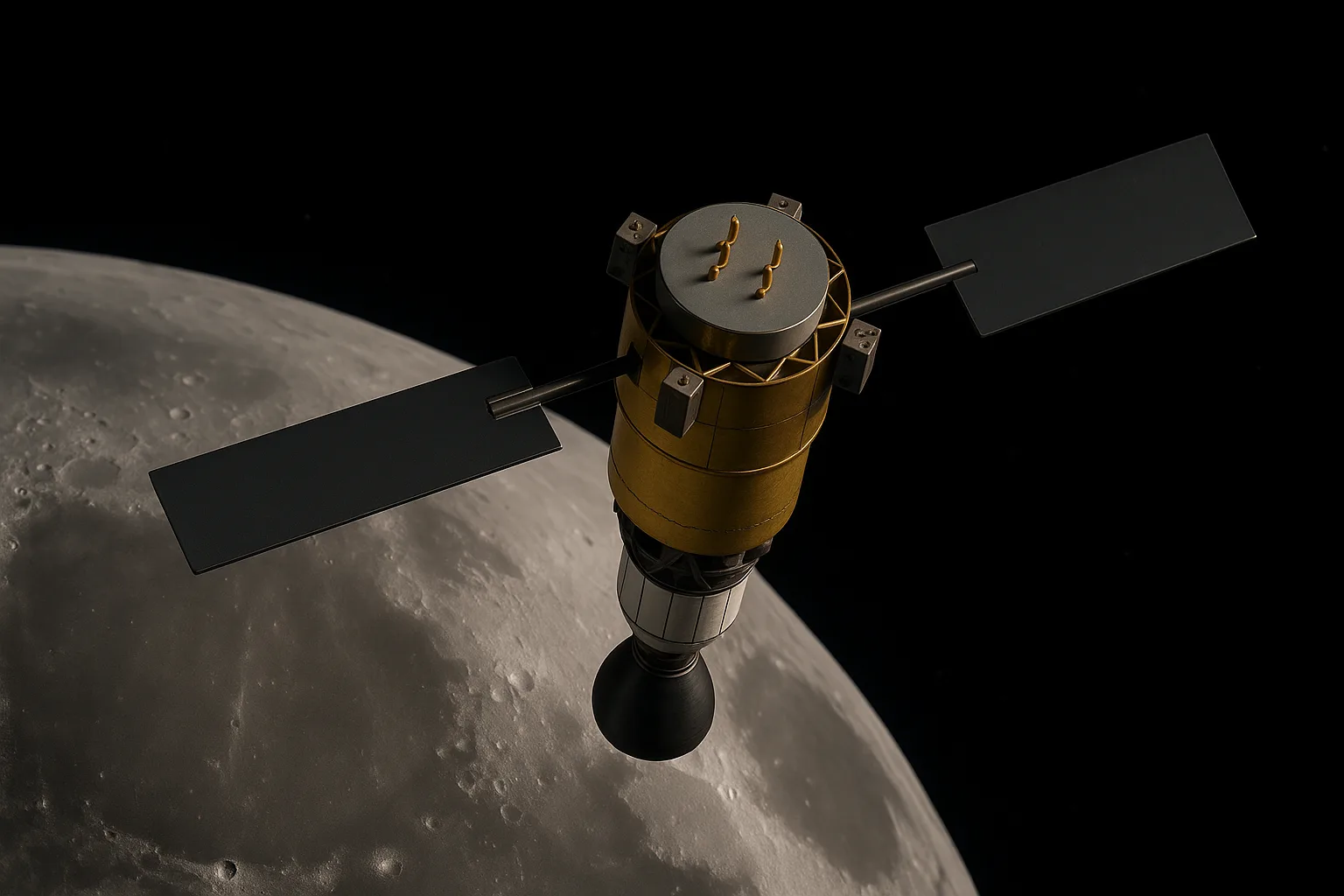
A nuclear thermal rocket engine built around a radial-inflow particle bed reactor. The physics is simple and unforgiving: exhaust velocity scales with the square root of temperature over molecular weight, so the winning move is to run the lightest propellant, hydrogen, as hot as materials allow. Everything in this engine is in service of that sentence.
How it works
Follow the hydrogen.
- Inward, always inward. Each fuel element is an annulus. Cryogenic hydrogen enters at the outer surface through thecold frit, a porous structure that meters flow into the bed. The cold frit is deliberately the dominant flow impedance in the element: it is what forces propellant to distribute evenly instead of finding one hot shortcut through the core.
- Through the bed. The propellant then flows radially inward through a packed bed of sub-millimeter coated fuel particles. A particle bed's surface-to-volume ratio is enormous compared with the drilled fuel rods of legacy NTP designs, which is what buys the architecture its defining property: very high power density in a compact, low-mass core. The hydrogen picks up nearly its full temperature rise across a bed just centimeters thick.
- Out through the hot frit. At the inner radius, a hot-side porous structure retains the particle bed while passing ~2,700 K hydrogen into the central outflow channel. The hot frit is the most demanding component in the engine: a structural material problem at temperatures where most engineering intuition stops applying. Solving it well is a core focus of our current test and analysis campaign.
- Expand and go. The heated hydrogen from all elements collects and expands through a conventional bell nozzle. No combustion anywhere in the cycle: the reactor is the heat source, the propellant is inert, and specific impulse lands at roughly twice the ~450 s ceiling of LOX/hydrogen chemistry.
Design targets
The numbers that matter.
| Propellant | Hydrogen at the design point; the architecture accommodates alternative propellants |
|---|---|
| Core architecture | Radial-inflow particle bed reactor (RI-PBR) |
| Reactor power, target | ~130 MW thermal |
| Chamber temperature, target | ~2,700 K class |
| Specific impulse, target | ~850–900 s (vs. ~450 s best chemical) |
| Thrust, target | ~6,000 lbf (26.7 kN) |
| Engine thrust-to-weight, target | 5–15 (high for NTP; the PBR's power density is the enabler) |
| Cycle | Closed expander; turbomachinery driven by heat recovered from engine structures |
| Heritage | Particle bed reactor concept ground-tested under the SNTP program (1987–1994) |
Figures are program design targets and are stated at the level of the published literature on particle bed reactor propulsion.
Why this architecture
Modernize, don't reinvent.
The particle bed reactor is not a paper concept. It was the basis of the Space Nuclear Thermal Propulsion (SNTP) program, which built and ground-tested hardware before the program ended with the Cold War. The physics worked; the 1990s tooling around it was the limit. Three decades later, the enabling technologies have moved decisively: high-temperature ceramics and refractory carbides, additive manufacturing of geometries that could not previously be fabricated, and computational fluid dynamics and neutronics capable of resolving the coupled thermal-hydraulic behavior of a packed bed before any fuel is loaded.
Our development approach reflects that: an intensive modeling and simulation campaign (CFD, FEA, Monte Carlo neutronics) running ahead of a stepwise test program on the components that carry the risk, frit structures, fuel element assemblies, and flow stability, under our SpaceWERX Direct-to-Phase-II contract.